Producing of Electric Vehicle Lithium-Ion Battery Pack

Electric Vehicle Lithium-Ion Battery Pack
Lithium-ion battery packs are the core energy storage components of electric vehicles (EVs), directly influencing vehicle range, safety, and lifespan. The production of EV lithium-ion battery packs is a complex, multi-step process that integrates material science, mechanical engineering, and electrical testing. This article systematically elaborates on the key production procedures, compares mainstream technological differences, and outlines international testing standards to provide a comprehensive understanding of the EV battery pack manufacturing landscape.

2. Core Production Processes of EV Lithium-Ion Battery Packs
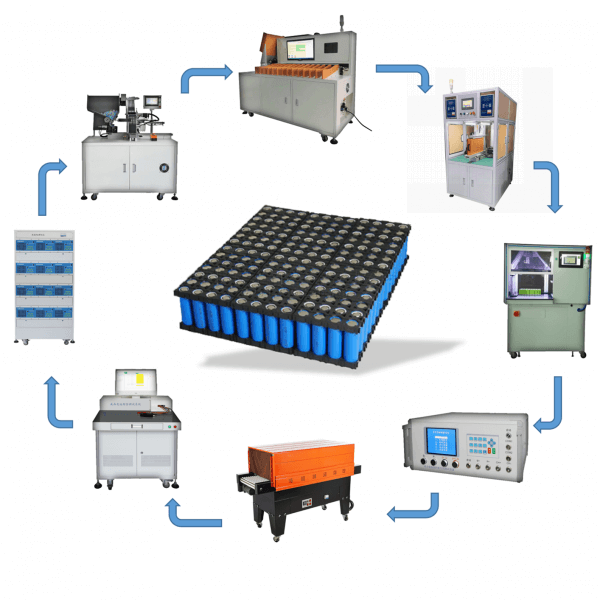
The production of EV lithium-ion battery packs typically follows a sequential workflow, from cell preparation to final assembly and testing. Each step requires strict quality control to ensure battery performance and safety.
2.1 Cell Selection and Pre-Processing
The first stage involves selecting appropriate lithium-ion cells (e.g., cylindrical, prismatic, or pouch cells) based on the EV’s design requirements (e.g., energy density, space constraints). Before integration, cells undergo pre-processing:
- Cell Sorting (Binning): Using automated equipment, cells are classified by capacity, voltage, internal resistance (IR), and self-discharge rate. This ensures consistency among cells in a pack, as mismatched cells can cause uneven charging/discharging and reduce overall pack lifespan.
- Electrode Inspection: For prismatic and pouch cells, visual and electrical inspections are conducted to detect defects such as electrode misalignment, separator damage, or electrolyte leakage.
2.2 Module Assembly
Cells are first assembled into modules—intermediate units that simplify pack assembly and maintenance. Key steps include:
- Cell Fixation: Cells are secured in a module housing (usually made of aluminum or composite materials) using gluing, clamping, or welding. For cylindrical cells, plastic or metal holders are often used to prevent movement during vehicle operation.
- Tab Welding: The positive and negative tabs of adjacent cells are connected via laser welding, ultrasonic welding, or resistance welding. Laser welding is preferred for its high precision and low heat input, which minimizes cell damage.
- Module-level Wiring: Voltage and temperature sensors are installed to monitor module performance. Wiring harnesses are routed and secured to avoid short circuits.
2.3 Pack Assembly
Modules are integrated into the final battery pack, along with structural, thermal, and electrical components:
- Module Installation: Modules are mounted onto the pack’s base plate (often with shock-absorbing gaskets) and secured with bolts. The layout of modules (e.g., series, parallel, or mixed configurations) determines the pack’s total voltage and capacity.
- Thermal Management System (TMS) Integration: TMS components—such as cooling plates, heat sinks, fans, or heat pipes—are installed to maintain cells within the optimal temperature range (20–40°C). For liquid-cooled systems, hoses and connectors are attached, and leak tests are conducted.
- Electrical Component Installation: The Battery Management System (BMS)—the "brain" of the pack—is mounted. The BMS controls charging/discharging, monitors cell health (State of Charge, State of Health), and triggers safety mechanisms (e.g., overcurrent protection). High-voltage connectors and fuses are also installed to ensure safe power transmission.
- Pack Enclosure Sealing: The pack’s top cover is attached, and a waterproof seal (using gaskets or adhesive) is applied to meet IP67 or IP68 dust and water resistance standards—critical for withstanding harsh automotive environments.
2.4 Final Testing and Quality Assurance
After assembly, packs undergo rigorous testing to verify performance, safety, and reliability:
- Electrical Testing: Includes voltage measurement, capacity testing (charging/discharging at different rates), and internal resistance testing. Packs must meet specified voltage and capacity thresholds (e.g., a 75 kWh pack should deliver ≥70 kWh of usable capacity).
- Safety Testing: Simulates extreme conditions such as overcharging, short-circuiting, and overcurrent. The pack should not catch fire, explode, or leak electrolyte.
- Environmental Testing: Involves temperature cycling (e.g., -40°C to 85°C), humidity exposure, and vibration testing (to mimic road conditions). The pack’s performance and structural integrity must remain intact.
- Leak Testing: For liquid-cooled packs, pressure tests are conducted to detect coolant leaks. For the entire pack, air pressure tests ensure waterproofing.
3. Technological Differences in EV Lithium-Ion Battery Pack Production
Technological variations in battery pack production primarily stem from cell type, assembly methods, and thermal management strategies. These differences impact production efficiency, cost, and pack performance.
3.1 Cell Type-Based Differences
|
Cell Type
|
Assembly Challenges
|
Production Efficiency
|
Cost
|
Energy Density
|
|
Cylindrical
|
Requires precise tab alignment; more welding points
|
High (automated)
|
Low-Medium
|
Medium
|
|
Prismatic
|
Larger size requires stronger structural support
|
Medium
|
Medium
|
High
|
|
Pouch
|
Fragile (no rigid case); prone to swelling
|
Low (more manual steps)
|
Medium-High
|
Very High
|
- Cylindrical Cells (e.g., Tesla 4680 cells): Benefit from high automation—Tesla’s Gigafactories use robotic arms for cell sorting and welding. However, the large number of cells (thousands per pack) increases the risk of welding defects.
- Prismatic Cells (e.g., CATL, LG Energy Solution): Popular in mid-to-high-end EVs due to their high energy density. Their rigid aluminum case simplifies handling, but module design requires more space for cooling.
- Pouch Cells (e.g., Samsung SDI): Offer the highest energy density but require careful handling to prevent damage. Pouch packs often use flexible cooling films instead of rigid plates, reducing weight but increasing production complexity.
3.2 Assembly Technology Differences: Traditional vs. Cell-to-Pack (CTP)
The traditional production process (cell → module → pack) is being challenged by Cell-to-Pack (CTP) technology, which eliminates the module level and integrates cells directly into the pack.
- Traditional Technology:
- Advantages: Easy maintenance (modules can be replaced individually); mature supply chain.
- Disadvantages: Lower space utilization (modules add structural weight); higher cost (extra housing and wiring).
- CTP Technology (e.g., BYD Blade Battery, CATL CTP 3.0):
- Advantages: Higher space utilization (up to 90%, vs. 70–80% for traditional packs); lighter weight (10–15% reduction); lower cost (5–10% savings).
- Disadvantages: Difficult maintenance (a single cell defect may require replacing the entire pack); stricter cell consistency requirements (mismatched cells have a greater impact on pack performance).
3.3 Thermal Management Technology Differences
Thermal management systems vary in cooling medium and design, affecting pack efficiency and cost:
- Air Cooling: Uses fans to circulate air through the pack.
- Advantages: Simple design, low cost, light weight.
- Disadvantages: Poor cooling efficiency (slow heat dissipation); ineffective at high temperatures. Common in low-cost EVs (e.g., some entry-level models).
- Liquid Cooling: Uses a coolant (e.g., ethylene glycol) circulating through cooling plates.
- Advantages: High cooling efficiency (maintains stable temperatures); suitable for high-performance EVs.
- Disadvantages: Complex design (requires pumps, hoses, and reservoirs); higher cost and weight. Used in most mid-to-high-end EVs (e.g., Tesla Model 3, BMW iX).
- Direct Liquid Cooling: A advanced variant where coolant directly contacts cells (via a dielectric fluid).
- Advantages: Superior heat transfer (30–50% better than indirect liquid cooling); enables faster charging.
- Disadvantages: High cost (specialized dielectric fluid); strict leak-proof requirements. Adopted by some premium EVs (e.g., Lucid Air).
4. Testing Standards for EV Lithium-Ion Battery Packs
To ensure global consistency in safety and performance, EV battery packs must comply with international, regional, and industry standards. Key standards include:
4.1 International Standards
- IEC 62133-2 (2017): Specifies safety requirements for lithium-ion battery packs in EVs, covering tests such as overcharging, short-circuiting, and mechanical shock.
- ISO 12405-1/-2: Focuses on performance testing, including capacity, charging/discharging efficiency, and cycle life. ISO 12405-2 specifically addresses dynamic discharge conditions (e.g., during acceleration and braking).
- UN38.3: Mandatory for battery transportation, requiring tests for altitude simulation, temperature cycling, and vibration to ensure safe transport.
4.2 Regional Standards
- United States (US):
- FMVSS 305: Regulates the safety of electric vehicle batteries, including tests for electrolyte leakage and fire resistance.
- UL 2580: Covers battery pack safety, including electrical, thermal, and mechanical tests. UL 991 (for BMS) is also commonly referenced.
- European Union (EU):
- EC Regulation No. 1235/2019: Sets performance and safety requirements for EV batteries, including durability (≥1,000 charge cycles or 8 years/160,000 km) and recyclability (minimum 50% material recovery by 2025).
- EN 50604-1: Specifies test methods for battery packs in electric road vehicles, including environmental and mechanical tests.
- China:
- GB/T 31485-2015: Defines safety requirements for EV battery packs, including overcharging, short-circuiting, and crush tests.
- GB/T 31467.3-2015: Focuses on performance testing, such as capacity, internal resistance, and cycle life.
4.3 Industry-Specific Standards
- Automotive Battery Consortium (ABC) Standards: Developed by major automakers (e.g., Ford, GM) and battery manufacturers, covering detailed test procedures for battery durability and reliability.
- Tesla Battery Standards: Tesla has internal standards for its 4680 cell packs, including stricter vibration and thermal cycling tests to meet its high-performance requirements.
The production of EV lithium-ion battery packs is a sophisticated process that requires precise control over cell selection, module/pack assembly, and testing. Technological differences—such as cell type, CTP adoption, and thermal management design—shape pack performance, cost, and maintainability. Compliance with international and regional testing standards is critical to ensuring battery safety, reliability, and global market access. As EV demand grows, future advancements (e.g., solid-state batteries, AI-driven BMS) will further optimize production processes and elevate battery pack performance, driving the transition to a more sustainable automotive industry.

Lithium Batteries VS Strong Acid Batteries
BMS Development-Battery Key Parameters and Definitions