Introduction to the Basics and Principles of UPS
Backup power sources during power outages and emergencies is more popular at present global new energy scale. Low electrification in semi-urban and rural areas has increased demand for power inverters. The widespread use of electronic devices and appliances such as cell phones, smart TVs, and air conditioners has increased the demand for backup power.
Introduction to the basics and principles of UPS uninterruptible power supply UPS, uninterruptible power supply equipment, refers to the power supply equipment that will not be interrupted due to short-term power failure, can always supply high-quality power supply, and effectively protect precision instruments. The full name is Uninterruptible Power System. It also has the function of stabilizing the voltage, similar to a voltage regulator.
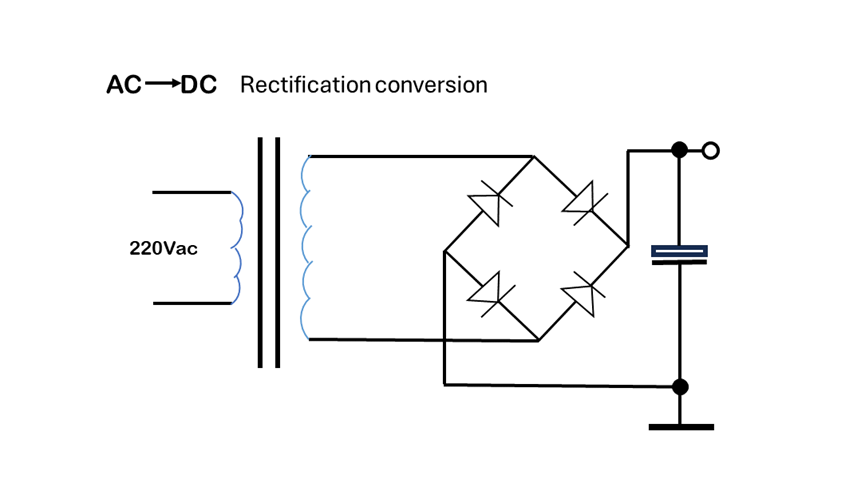
In terms of basic application principle, UPS is a power protection device containing energy storage device, with inverter as the main component, and stable voltage and frequency output. It is mainly composed of rectifier, battery, inverter and static switch. 1) Rectifier: A rectifier is a rectifier device, which is simply a device that converts alternating current (AC) into direct current (DC). It has two main functions: first, it converts alternating current (AC) into direct current (DC), which is filtered to supply the load or to the inverter; Second, the battery is charged at a voltage that is charged. Therefore, it also functions as a charger;
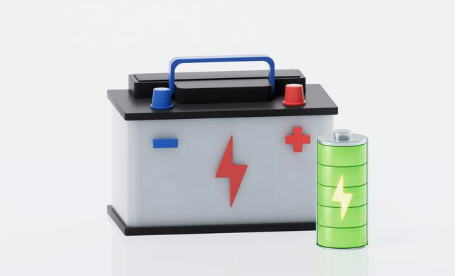
2) Battery: The battery is a device used by UPS to store electrical energy, which is composed of several batteries in series, and its capacity determines the time it maintains discharge (power supply). Its main functions are: 1. When the mains power is normal, it converts electrical energy into chemical energy and stores it inside the battery. 2. When the mains power fails, the chemical energy is converted into electrical energy and provided to the inverter or load;
3) Inverter: An inverter is a device that converts direct current (DC) into alternating current (AC). It consists of an inverter bridge, control logic, and filter circuits;
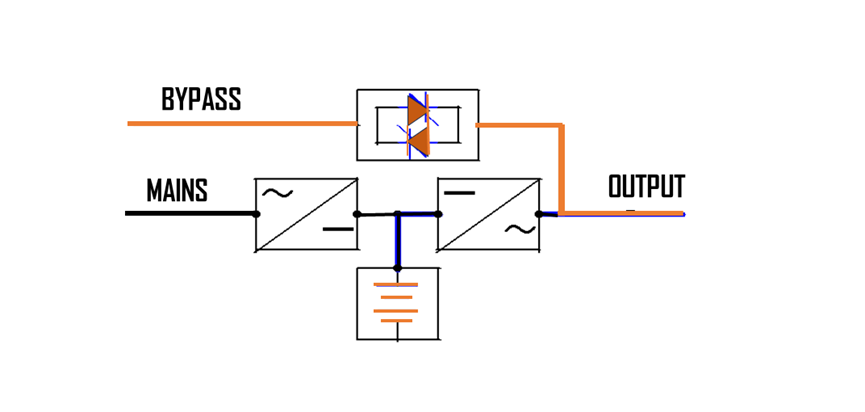
4) Static switch: Static switch, also known as static switch, is a kind of non-contact switch, which is a kind of AC switch composed of two thyristors (SCR) in reverse parallel, and its closing and disconnection are controlled by the logic controller. There are two types: conversion type and parallel type. The transfer switch is mainly used in the system of two power supply channels, and its function is to realize the automatic switching from one to the other; Parallel switches are mainly used to connect parallel inverters with mains power or multiple inverters.


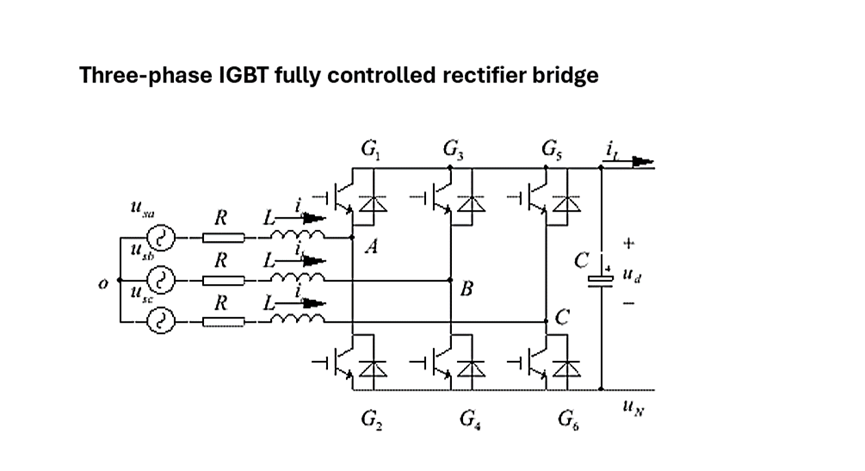
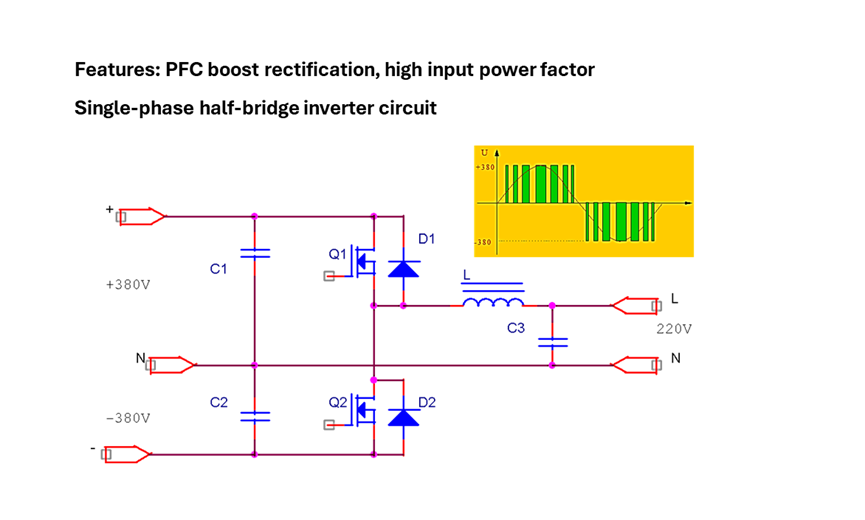
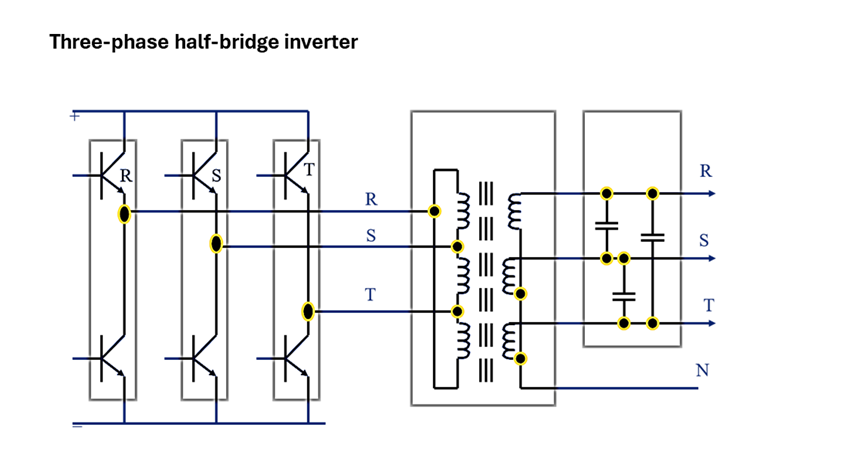
Commonly used devices:
Passive Components:
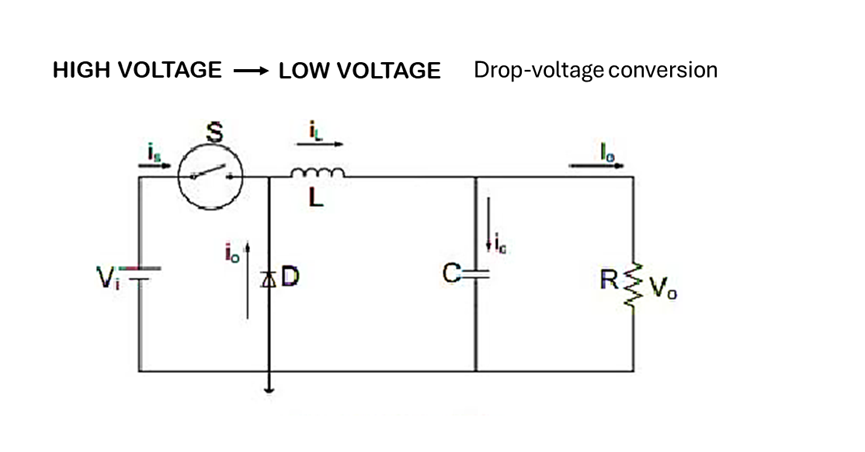
Resistance – Consumes electrical energy, voltage and current are in phase
Inductance – generates a magnetic field to store magnetic field energy, on-DC resistance, AC, current hysteresis voltage
Capacitance – generates an electric field to store electric field energy, AC resistance DC, and current ahead of voltage
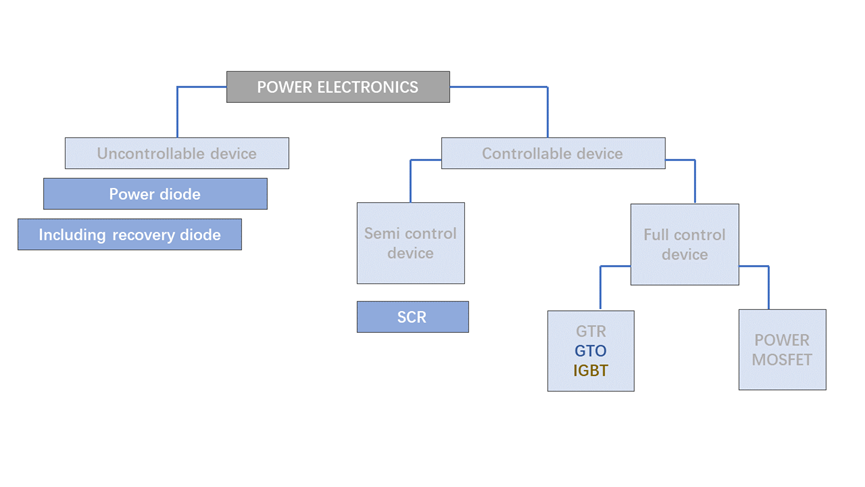
IGBT: Insulated gate bipolar transistor fully controlled device: controllable turn-on and controllable turn-off
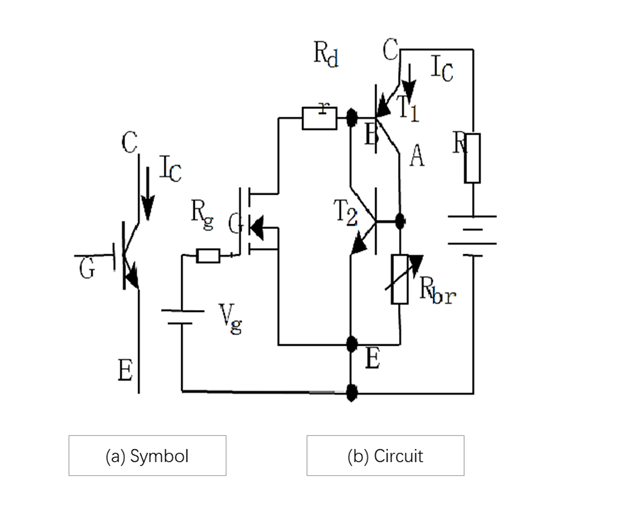
Device features: high input impedance; Voltage-type control device, small driving power; The switching speed is fast, and the working frequency can reach 10-100KHz; Saturation voltage reduction (much smaller than MOSFETs); The voltage and current capacity are large, and the safety working area is wide. Usually reverse integrated body diodes
Semiconductor Power Devices:
UPS classification
According to the different power supply systems, UPS is divided into:
Single-in, single-out UPS
Three-in, single-out UPS
Three-in, three-out UPS
According to the different output power, UPS is divided into:
Low power (< 10kVA) Medium power (10 to 30kVA) High power (>30kVA)
According to the characteristics of the transformer, UPS is divided into:
High Frequency UPS (High Frequency Machine)
Power Frequency UPS
According to the different working principles, UPS is divided into:
Back-up UPS
Online interactive UPS
On-line UPS
How the back-up UPS works
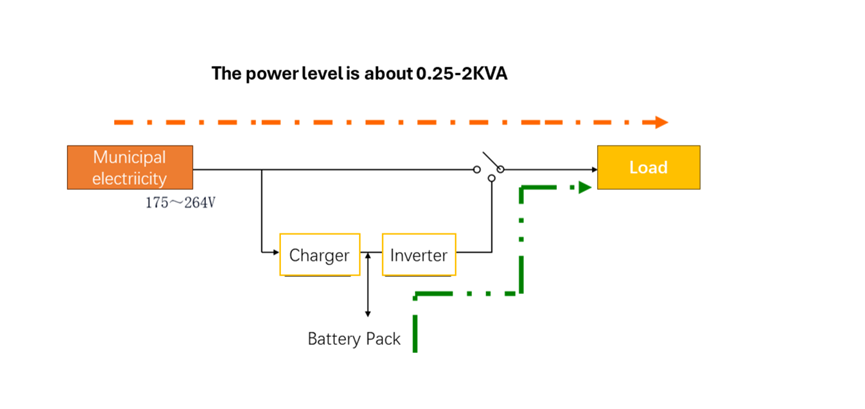
Features: The inverter does not work when the mains power is normal, and the switching time is long
How interactive UPS works
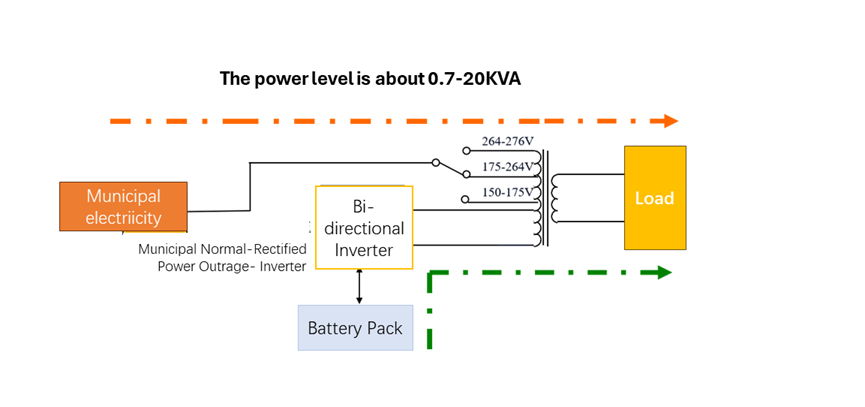
Features: The inverter and charger are combined into one to achieve segmented voltage regulation
How does an online UPS work
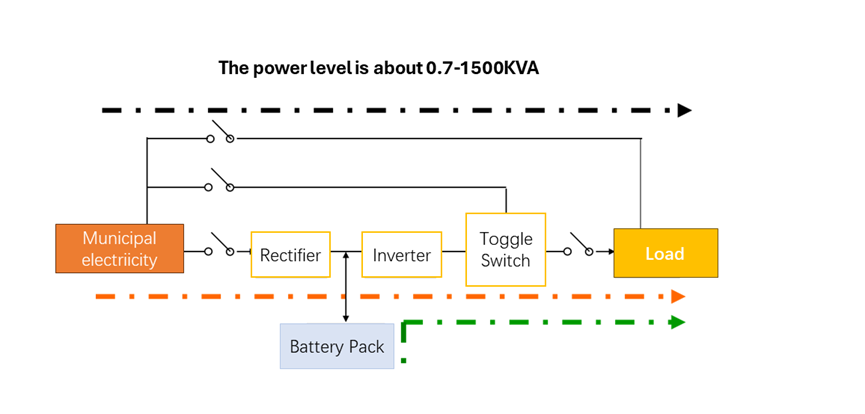
Features: Under normal circumstances, the inverter circuit is always in working condition
Battery inverter working mode:
When the mains power of the main circuit is power-off or abnormal, the system automatically switches to the battery working mode without interruption, and the battery inverts the three-phase four-wire AC power supply required by the user to supply power to the load. After the mains power is restored, the system will automatically return to normal working mode without interruption, as shown in the figure:

Static bypass operation mode:
There are two ways to work in the bypass, one can automatically return to normal working mode; The other requires human intervention to get back into normal working mode. In the case of the inverter overload delay time and the inverter being impacted by large loads, the system automatically switches to the static bypass power supply to supply power to the load without interruption. After the UPS returns to normal, the system automatically resumes the normal power supply mode.
When the user shuts down, or the mains power is off (or abnormal) and the battery energy storage is exhausted, or a serious fault occurs, the inverter is turned off and the system will stay in bypass working mode. After that, if you need to return to normal working mode, you need to reboot the computer, as shown in the figure:
Maintenance working mode:
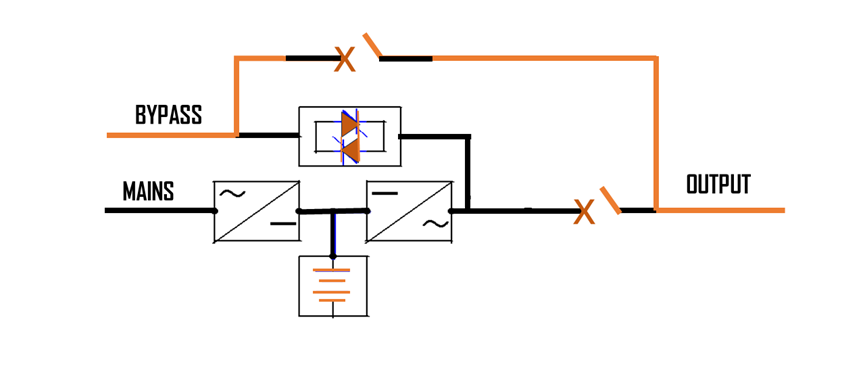
When it is necessary to overhaul the UPS power supply and battery or repair the equipment failure, the load can be turned to the maintenance bypass and directly supplied by closing the maintenance switch Q3BP, so as to realize the maintenance of the UPS without power interruption. Maintenance needs to disconnect the main circuit, bypass input power supply, battery input switch and output switch inside the UPS, so as to realize the maintenance working mode of maintaining power supply to the load without power inside the UPS, as shown in the figure:
Outdoor UPS Features
- A wide operating temperature range
- Optional add-on battery cabinets provide longer back-up times
- Long life batteries reduce maintenance costs
- Remote monitoring and control
- Temperature compensated battery charging
- Compact design
- Independently programmable control and reporting
- Ready-to-install
Pure Sine Wave Inverter VS Modified Wave DC-AC Inverter
The Introduction of PV inverter MPPT